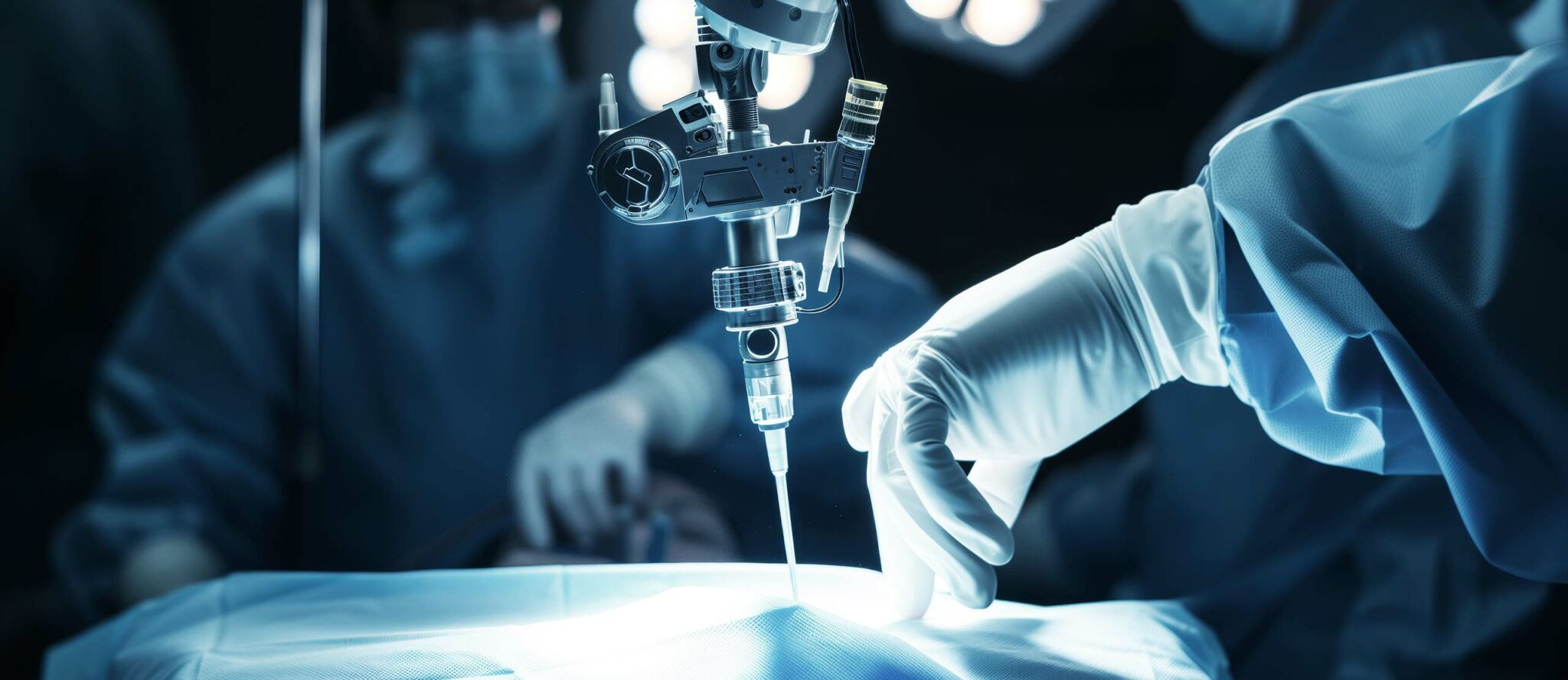
The Master’s Programme in Robotic Surgery and Intelligent Systems (RoSI) provides advanced training focused on robot-assisted minimally invasive surgery and artificial intelligence applied to oncological and general surgery.
Through theoretical and hands-on lectures and interaction with national and international experts, the programme aims to present the most recent surgical techniques and technological innovations available to improve the effectiveness and safety of surgical procedures. Participants will develop expertise in robotic platforms, applied artificial intelligence, fluorescence-guided surgery, real-time assistance models, and biosensors.
The Master’s Programme enables participants to apply knowledge in practice, critically evaluate emerging technologies, and effectively communicate with other surgeons, fostering continuous professional development and improving the quality of patient care.
Robotic surgery is increasingly establishing itself as an alternative to laparoscopic surgery, and the rapid expansion of robotic systems requires today’s surgeons to gain proficiency in this technology. Furthermore, the growing use of artificial intelligence in healthcare and surgery is expected to further enhance clinical practice.
The RoSI Master’s Programme represents a high-level educational opportunity designed for specialists and residents in General Surgery, Urology, Gynecology, and other surgical disciplines who wish to deepen their expertise in advanced robot-assisted techniques for the treatment of oncological diseases.
Participants will acquire advanced skills to:
- Integrate robotic techniques into daily clinical practice, improving treatment delivery, surgical effectiveness, and patient outcomes.
- Apply innovative technologies to enhance the treatment of abdominal oncological diseases and other clinically relevant conditions.
- Leverage cutting-edge technologies for intraoperative support, including AI-based decision-support systems, fluorescence imaging techniques to improve tissue visualization and surgical safety, and real-time assistance models that enhance intraoperative control.
The Master in Robotic Surgery and Smart Systems (RoSI) is addressed to General Surgery experts and residents, who wish to explore the role and use of robotic platforms in oncological surgery, general surgery, and in new AI-based surgery technologies. Attendees will actively take part in discussing the methods, analysing and presenting clinical cases. Lessons have a strong practical component, entailing the use of videos and digital materials, and observation in the OR. National and international experts with a solid experience in robotic surgery and AI applications in the surgical field will intervene during the lessons.
At the end of the course, attendees will be able to improve patient care quality, and help increase the standards of oncological and mini-invasive robotic surgery.
Robotic Surgery
- History and development of robot-assisted surgery
From its origins to the latest innovations: evolution of robotic surgery and currently available and emerging platforms. - Basic techniques
Operating room setup, instruments and devices, and fundamental technical skills. - Upper GI Surgery
Robotic approach to esophageal and gastric cancers. - Colorectal and inflammatory bowel disease surgery
Robotic management of colon and rectal diseases and IBD. - Hepatobiliary and pancreatic surgery and liver transplantation
Robot-assisted surgical treatment of liver and pancreatic malignancies. - Urological and pediatric urological surgery
Role of robotic surgery in kidney, bladder, and urinary tract cancers. - Gynecological surgery
Role of robotic surgery in gynecological oncology. - Multidisciplinary surgical approach to the pelvis
Advanced multi-team surgical techniques for complex pelvic malignancies. - Breast surgery
Recent applications of robotic surgery in the treatment of breast cancer. - Abdominal wall surgery
Applications of robotic platforms in the repair of abdominal wall defects. - Single-port robotic surgery
Single-port robotic platforms: development and current applications. - New applications of robotic surgery
Emerging uses in sarcoma surgery and vascular surgery. - Ethics, economics, and sustainability of robotic systems
Impact of robotic approaches on the doctor–patient relationship, healthcare management, and the environment.
Intelligent Systems
- Fundamentals of Machine Learning and Generative AI
Basic concepts tailored for clinicians. - Radiomics
Advanced AI-supported diagnostics to enhance radiological assessment. - Artificial Intelligence in Surgery
From devices to smart operating rooms: how AI is transforming surgical practice. - Computer Vision and Real-Time Imaging
Role of enhanced visualization technologies in the operating room, including training, simulation, and intraoperative imaging tools. - Endoscopy and AI
Robotic systems for endoscopy and machine learning applications to improve diagnosis. - Biosensors
Innovative tools for post-operative monitoring. - Telesurgery
Development of remote surgical systems, with current and future applications.
The Master includes 300 hours of theoretical/hands-on lessons. Lessons will be held on weekday afternoons, remotely. Lesson days will be defined and agreed upon by the Course Director, Professors and Attendees.
Attendees will have the chance to attend robotic surgeries as observants, in the ORs of the Padua University Hospital.
Small-group hands-on simulations on simulators and workshops will also be held in person.
- Prof. Imerio Angriman, General Surgery 3, DISCOG, UniPD
- Prof. Francesco Bianco, Division of General, Minimally Invasive & Robotic Surgery, University of Illinois at Chicago, USA
- Prof. Giorgio E. Bonacchini, Dip. DEI, UniPD
- Prof. Patrizia Burra, Director of Gastroenterology and Multivisceral Transplants, DISCOG, UniPD
- Dr. Francesco Celotto, General Surgery 3, AOPD
- Prof. Umberto Cillo, Director of Hepato-Bilio-Pancreatic Surgery AOPD, Director of DISCOG, UniPD
- Prof. Fabrizio Dal Moro, Director of Urology AOPD, DISCOG, UniPD
- Dr. Giovanni Ferrari, Director of General Oncological and Mini-Invasive Surgery, Niguarda Hospital
- Dr. Isabella Frigerio, Hepato-Bilio-Pancreatic Surgery, Pederzoli Hospital (VR)
- Dr. Guglielmo Gazzetta, Istituto di Candiolo IRCCS (TO)
- Prof. Andrew Gumbs, Dir. Artificial Intelligence Surgery all’Hôpital Antoine Béclère, Assistance
- Publique-Hôpitaux de Paris, France
- Dr. Isacco Maretto, General Surgery 3, AOPD
- Prof. Emilio Quaia, Istituto di Radiologia, DIMED, UniPD
- Prof. Carlo Saccardi, Obstetrics-Gynaecology Clinic, Dep. SDB, UniPD
- Prof. Barbara Seeliger, IRCAD, Research Institute against Digestive Cancer, Strasbourg, France
- Prof. Alessandro Sperduti, Mathematics Department, UniPD
- Prof. Gaya Spolverato, Director of General Surgery 3 AOPD, DISCOG, UniPD
- Prof. Roberto Tozzi, Director of Obstetrics-Gynaecology Clinic, Dep. SDB, UniPD
The general ranking of merit for the academic year 2025/26 will be published on the Italian page of this Master according to the timing provided in the Call.
Information
FAQ
No, OR activities will be observation-only.
During the lessons, workshops and small group simulations will be held, with training material and instruments.
There will be one final exam, encompassing all the modules, on a date to be agreed on at the end of the course.
Attendees must attend at least 70% of the lessons.
No more than 30% of absences will be allowed.