The First-level short specialisation degree in Nursing Care in Intensive and Emergency Areas provides the skills necessary for nursing care management in critical situations for adult patients, in hospital and non-hospital settings.
In-class activities are focused on the acquisition of advanced cross-sectional skills, such as identification, planning, implementation and assessment of advanced care interventions; communication abilities; multi-professional team-working skills.
The diversified traineeships help students acquire specific advanced competencies, such as: advanced airway management (weaning, intubation with supraglottic airway devices), ultrasound techniques (eco-fast, peripheral vascular access), advanced hemodynamic monitoring, renal replacement therapy management, care-related infection containment strategies, multi-trauma and brain-injured patient management.
The course units of the First-level short specialisation degree in Nursing Care in Intensive and Emergency Areas include 400 hours of classroom learning, including hands-on workshops and simulation activities, and 300 hours of apprenticeship in matching critical area operating units, at the University Hospital of Padua and affiliated institutions (e.g., AULSS 6).
The First-level short specialisation degree in Nursing Care in Intensive and Emergency Areas is addressed to all professional nurses with a Bachelor’s Degree or equivalent title; it is also conditionally open to undergraduates of the November-December 2023 graduation session.
After obtaining the Second-level short specialisation degree’s diploma, nurses become specialized professionals capable of applying the advanced competencies acquired in specific contexts, such multipurpose or specialist intensive and sub-intensive care units, in hubs, E.R., operating centres and operating rooms.
Furthermore, the Second-level short specialisation degree is a mandatory requirement to access specialist professional functions, as regulated by Law no. 43/2006, implemented by CCNL 2019-2022 and applied by several healthcare companies and units, through internal regulations or resolutions.
Classroom lessons of the First-level short specialisation degree in Nursing Care in Intensive and Emergency Areas are divided into three macro-areas, each one comprising several teaching modules. Each module is formulated according to functions and/or body systems typical of the ABCDE evaluation, by professors belonging to different professional profiles, such as: doctors, expert and specialized nurses, cardiovascular perfusion technician, neurophysiopathology technician, physical therapist and dietician.
CARDIAC-RESPIRATORY AREA
- Non-hospital and E.R. assistance
- Monitoring and support of respiratory functions
- Monitoring and support of hemodynamic functions
SPECIALIST AREA
- Monitoring and support of neurological functions and pain
- Monitoring and support of metabolic functions
- Monitoring and support of renal functions
- Monitoring and support of critically pediatric patient
- Wound care and thermal regulation
- Medical risk management
LAW AND RESEARCH
- Research and teamwork
- Law and bioethics
Included in the registration fee, the First-level short specialisation degree offers Basic Life Support (BLSD), Advanced Cardiovascular Life Support (ACLS) courses and the course PreHospital Trauma Life Support (PHTLS) with certified instructors. It also guarantees the Safety course for specific risk (High Risk) according to Legislative Decree 81/08 and the possibility of taking the Pediatric Advanced Life Support (PALS) course at a discounted rate.
In-class teaching: 400 hours comprising in-person lessons, workshops and practice. Class days are intensive, and comprise morning and afternoon. Presence in the classroom is expected.
Lessons of the First-level short specialisation degree in Nursing Care in Intensive and Emergency Areas will be held in two time periods: from November 2024 to May 2025 and from November 2025 to May 2026 at the Istar Lecture Hall (Palazzina Servizi Tecnici at the University Hospital of Padua, 2nd floor – Via Vincenzo Gallucci no. 13, Padua) and at the Skill Lab of the School of Medicine (via Giovanni Battista Belzoni n.160, Padua).
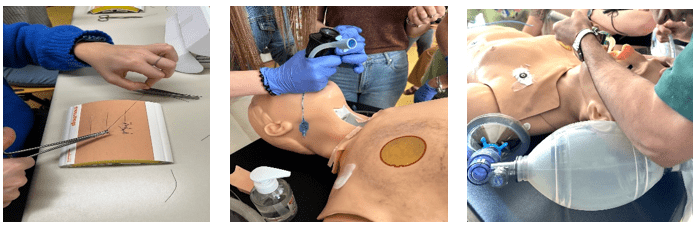
Workshops and practice on: eco-fast, eco-guided peripheral vascular access, intraosseous access, advanced airway management, basic management of the mechanical ventilator, suture course, Basic Life Support (BLSD) course and Advance Life Support (ALS) practice with certified American Heart Association (AHA) instructors.
Traineeship: it includes 2 stages, each one 150 hour long, between: emergency and trauma, invasive ventilation, non-invasive ventilation, vascular access, advanced hemodynamic, renal replacement therapy, brain-damaged patients, care-related infections. Based on the path chosen, matching critical area operating units of the University Hospital of Padua and affiliated entities (Aulss6) will be assigned.
The traineeship takes place in two periods from June to September 2025 and from June to September 2026, with the option of scheduling it in a facilitated manner for working students.
A mandatory 70% attendance is required for all learning activities and 100% for the internship.

Lesson calendar:
– 6,9,10,11 December 2024 from 9.00 to 18.00
– 7,8,9,10 January 2025 from 9.00 to 18.00
– 4,5,6,7 February 2025 from 9.00 to 18.00
– 4,5,6,7 March 2025 from 9.00 to 18.00
– 1,2,3,4 April 2025 from 9.00 to 18.00
– 6,7,8,9 May 2025 from 9.00 to 18.00
The calendar may be subject to change, educational workshops and certified courses are not included.
The selection test will be oral on the basic topics of nursing care in critical care.
The selection test will be held in the Castellino Hall located on the ground floor of the Polyclinic of the Padua University Hospital on the following days and times:
– 14 October 2024, from 10.00 to 14.30
– 15 October 2024: from 9.00 to 12.00
At the end of pre-registration, the First-level short specialisation degree‘s Secretariat will provide the candidates with the selection test calendar via email.
The general ranking of merit for the academic year 2024/25 e 26 will be published on the Italian page of this First-level short specialisation degree according to the timing provided in the Call.
Information
FAQ
The First-level short specialisation degree has a limited number of participants. The selection method is score-based, by assessing the titles and the years of working experience, through the resume submitted in the pre-registration phase. The score obtained is added to the oral exam, revolving around intensive care and non-hospital/E.R. emergency topics.
The course recognizes the BLSD, ACLS, PHTLS course and the specific Safety – High Risk course (L.n. 81/08) for those students that, after being admitted, will provide the relevant documents, after suitable evaluation by the First-level short specialisation degree’s Administrative Office.
Working students may request annual educational leaves at their own companies, to carry out educational or traineeship activities. The First-level short specialisation degree’s Administrative Office will provide help and the additional documentation required by companies.
The course entails the following intermediate tests: an individual paper on bioethics and professional responsibility; a teamwork on medial risk topics; a multidisciplinary multiple choice test on the relevant subjects before accessing the medical traineeship.
At the end of the academic year, students will be required to draft and present a short project work, consisting in the revision of literature on intensive or emergency care topics, or in an improvement project to be implemented in their own Operating Unit or traineeship location.