
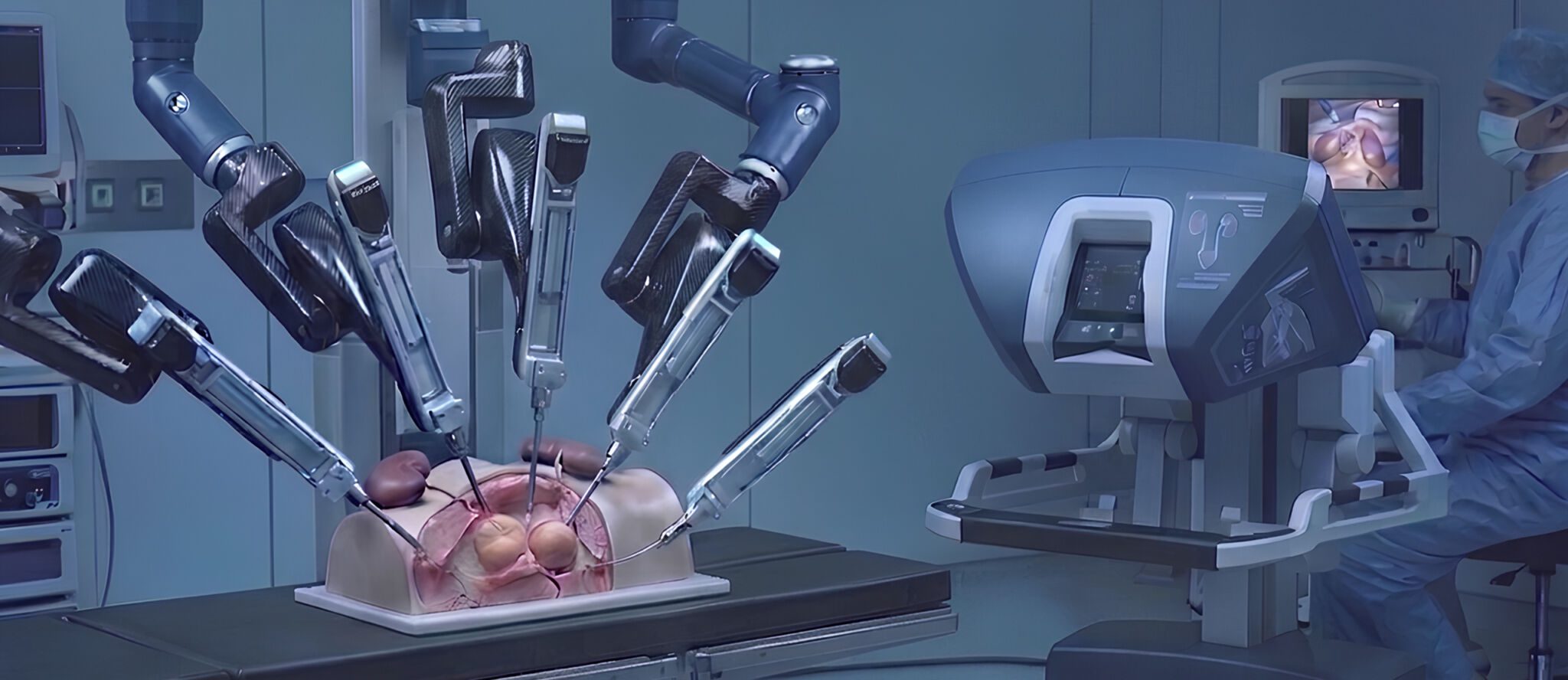


The Master’s Degree FUT.U.R.A. – The Future of Robotic Surgery in Urology, provides advanced training on robot techniques applied to urological surgery and on the most recent innovations in mini-invasive surgery.
This Course stems from the recent diffusion of robot platforms in surgery, and the consequent demand for highly qualified professionals who can use those technologies in a safe and effective manner.
By working alongside highly-specialized medical centres and expert professionals, the Master will help attendees develop professional skills they can immediately spend in the contemporary healthcare context, by training specialists capable of tackling medically-advanced challenges and respond to the new demands in the healthcare system.

The Master’s Degree FUT.U.R.A. – The Future of Robotic Surgery in Urology covers the main theoretical and practical aspects of robotic urological surgery, and focuses especially on surgery planning, robot platform usage, perioperative patient management, and clinical outcome evaluation.
The Course combines medical, technological and organizational skills, promoting a multi-disciplinary approach of advanced surgical practice. It combines different educational methods, such as theoretical sessions, hands-on practice and vocational workshops to help attendees develop cutting-edge expertise on robotic urological surgery.
The Master’s Degree FUT.U.R.A. – The Future of Robotic Surgery in Urology is addressed mainly to Urology Specialists or Residents, and to healthcare professionals interested in acquiring advanced skills in robotic urological surgery and in mini-invasive surgery techniques.
Additionally, the Course could be interesting for professionals involved in the development, management and implementation of robot technologies in the healthcare sector, and for healthcare workers employed in hospitals with a high level of technological innovation.
Attendees may leverage the skills acquired to work in highly-specialised medical contexts, such as urology wards, robot surgery centres, public and private hospitals, and clinical research centres. Moreover, the Master develops many useful skills for technological research, innovation and transfer activities, in the advanced medical technology sector.
The Master’s Degree FUT.U.R.A. – The Future of Robotic Surgery in Urology provides in-depth training on the following topics:
Module 1 – PRINCIPLES OF ROBOTIC UROLOGIC SURGERY
Operating principles of robot systems, ergonomics, safety, set-up, and essential surgical phases.
Module 2 – SURGICAL ANATOMY APPLIED TO ROBOTICS
Pelvic and retroperitoneal anatomy, critical structures and dissection plans.
Module 3 – SURGERY TECHNIQUES TO TREAT MALIGNANT KIDNEY, BLADDER AND PROSTATIC CANCER
Technical and procedural aspects of robotic surgery to treat the main urological malignancies.
Module 4 – PERIOPERATORY MANAGEMENT IN ROBOTIC SURGERY ACCORDING TO ERAS PROTOCOLS
Principles and application of ERAS (Enhanced Recovery After Surgery) protocols in robotic urologic surgery. Pre-surgery optimization strategies, patient preparation and selection, multi-modular intra-operative management, early post-surgery recovery procedures.
Module 5 – MANAGING PERI- AND POST- ROBOTIC SURGERY COMPLICATIONS
Prevention, recognition and management of complications arising during and after robotic urologic surgeries. Main intra-operative events and post-surgery complications. OR emergency management protocols, conversion strategies, use of decision-making algorithms, and video-reviews on actual cases.
Module 6 – COMMUNICATION AND TEAMWORK IN THE OR
Communication and social skills required to work in a highly-complex surgical team, especially in robotic urologic surgery.
Module 7 – IMAGING AND AI IN ROBOTIC SURGERY
Image-guided surgery principles, intra-operative fusion imaging with pre-surgery data (TC, RM, PSMA PET/CT), and use of 3D models for surgical planning and navigation.
Module 8 – ROBOTIC SURGERY IN PAEDIATRIC PATIENTS
Main robotic surgery applications in paediatric patients, with a focus on congenital and acquired urological diseases.
Module 9 – SURGERY TECHNIQUES TO TREAT BENIGNANT KIDNEY, BLADDER AND PROSTATIC CANCER
Technical and procedural aspects of robotic surgery for benignant urological diseases. Operational phases of robotic pyeloplasty, adenectomy or prostatic enucleation, and bladder or urethra reconstruction surgery.
Module 10 – ALTERNATIVES TO THE DA VINCI ROBOT PLATFORM: VERSIUS
Description of the modular design, ergonomics, technical features, and system operation principles, compared to previous-generation robots.
Module 11 – SINGLE PORT DA VINCI SYSTEM
Platform configuration, hinged instrument management, surgical space management, and access strategies to pelvic, retroperitoneal and bladder sites.
The Course comprises frontal lectures, seminars and insights on clinical topics, robotic surgery technologies and methods, and mini-invasive urology techniques. It focuses especially on robotic technology, surgery planning, and clinical management of patients undergoing robot-assisted procedures.
Moreover, the Master includes hands-on and lab practice to acquire operational skills, with the help of simulators, robotic platforms and other advanced technologies, provided in partnership with hospitals and clinical centres.
Finally, it comprises internships and field training in partner urology wards and hospitals, during which attendees will observe and participate in the different stages of the robotic surgery treatment.
The Course will end with a project work or final dissertation on a topic related to robotic urological surgery, clinical research, or technological innovation applied to surgical practice.
The general ranking of merit for the academic year 2026/27 will be published on the Italian page of this Master according to the timing provided in the Call.
Information
FAQ
The Master will take place between January 2027 and October 2027.
Attendance of at least 70% of the total hours is mandatory.
Yes, the Course includes hands-on and lab practice on advanced simulators and, if feasible, direct practice of robot platforms. These experiences are designed to help attendees develop operational expertise, in a controlled and gradual context, by supporting theoretical training with hands-on practice.